Once Upon a Time
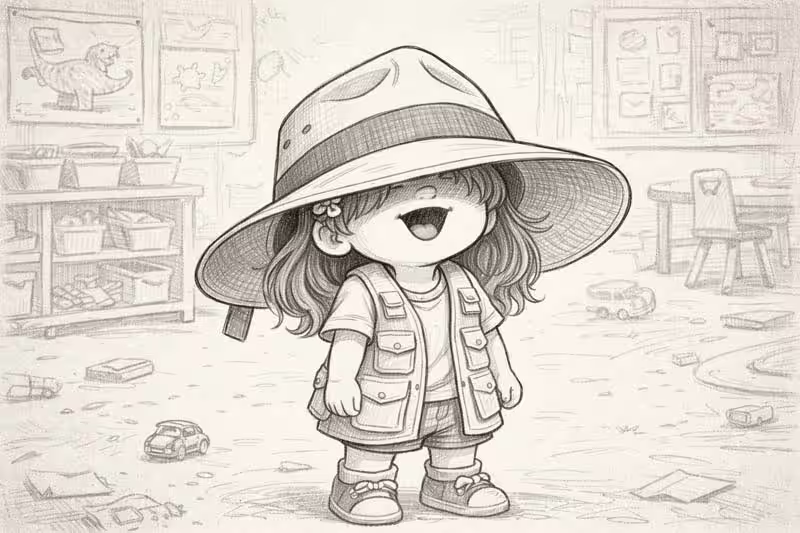
Dr Thorne Wilde had once faced one of the great desert lions with nothing more than a rope, a compass, and what he later described as a “firm demeanour”.
He had spent three days and two nights stuck in the boughs of a Dank Willow in the middle of a swamp until the various slithering creatures camped under him had moved on.
He had, on four separate occasions, escaped bubbling sink-mud using nothing but his wits.
And yet, as he stood outside Green Apple Kindergarten with one large hand frozen over the handle of a door gaily painted and plastered with all manner of animals, flowers, and faces, Dr Thorne felt a bead of sweat crawl down his temple.
Behind the door, barely muffled, came shrieking, laughing, and the unmistakable sound of a small object striking the wall at speed.
A jungle, he thought, but indoors.
The door flew open, nearly yanking him with it. Standing beyond was an energetic, bright-eyed young woman with wild, curly blond hair. She wore a long, flowing skirt and a yellow cardigan with the sleeves loosely rolled up over her elbows.
“Dr Thorne Wilde!” cried Miss Sunshine, and, true to her name, she beamed at him with a wide, toothy smile. “You’re here!”
She turned and clapped her hands as though she had summoned a celebrity from the heavens. “Children! Children, quiet, please! Our guest has arrived!”
Dr Thorne ducked through the doorway, holding his satchel in front of him like a shield, immediately feeling bad about the mud-caked boots and dusty clothes he was wearing. The smell that permeates all classrooms full of young, excitable children hit him like a physical force. He held out a much battered piece of paper to Miss Sunshine, trying his best to breathe through his mouth. “I, em, thank you for your letter.”
“Oh, no problem at all! We’re just so happy to have you here!” She smiled at him, and he’d need to be made of stone if he didn’t find it infectious.
He looked around him at the classroom. He guessed that nearly thirty children, anywhere between three and five years old, were present - he wasn’t great at guessing the ages of young children. They stared at him, frozen in various poses from whatever they were doing before, with nearly identical expressions - wide-eyed and gape-mouthed. There was something about the open, honest gaze of the very young that he found disconcerting.
As he looked over their dirt and snot-streaked faces, one of the boys slowly stuck one curled finger up his nose, all while staring Dr Thorne dead in the eyes. Judging by the depth the finger disappeared to, the boy must have been digging for gold.
Dr Thorne gave an awkward smile and cleared his throat.
“You have a moustache!” piped one of the girls.
Dr Thorne wasn’t expecting this. “Sorry, I, what?”
“My mother has a moustache,” she continued solemnly.
“Your… Surely you mean your father?” he asked hopefully.
She looked at him, confused.
“Do you get a load of food caught in it?” shouted another boy, much too loudly, before she could answer.
“What? No, no, I don’t,” Dr Thorne said quickly. Well, he did, but he didn’t want to say that to the boy.
“Why are you so big?” came another voice near the back. “You need a bigger shirt,” added another boy, nodding.
“I, eh, exploring is hard work. I do a lot of climbing. And my shirt is fine,” he added, shooting a narrow glare at the last one to talk.
“Miss Sunshine says we’re not allowed to climb,” said a little girl, as if catching him in a great big lie.
Miss Sunshine clapped her hands delightedly at that. “Dr Wilde is allowed to climb because of his job. He’s one of the greatest explorers in the world. He knows more about gems and creatures than anyone else alive.”
“What about anyone dead?”
“Them too,” said Dr Thorne dryly.
Miss Sunshine wisely swept onward before the kids could get too far down that rabbithole. “Dr Wilde has very kindly come to tell us all about the history of our world.”
The kids didn’t seem too impressed with this, but seemed to accept that they were going to get a story. They all sat down on the floor and gazed up at him with their heads practically bent backwards in two.
Dr Thorne had given talks before. To scholars, to scientists, and even other explorers. This, he suspected, would be harder.
Miss Sunshine brought over a little chair for him.
Dr Thorne looked at it.
The chair looked back, with a sort of cheerful malice. It was about the same size as the ones the kids sat on. Miss Sunshine nodded at him encouragingly.
With grim resignation, Dr Thorne gingerly lowered himself onto it. It let out a low creak, and his breath caught, but it held. His knees were up under his chin. Truth be told, he would be nearly better off sitting on the ground.
“Now, children,” Miss Sunshine said, addressing the earnest faces in front of her. “Let’s all put on our listening ears.” She cupped her hands behind her own ears.
A handful of the children copied her gesture.
Dr Thorne cleared his throat. He should have brought some water. “Good morning.”
“Good morning!” shouted the children, causing him to wince. That was loud. “Good morning,” echoed one child at the back, five seconds behind everyone else.
“As your teacher has said,” he gave her a nod here, and she radiated good cheer back at him, “my name is Dr Thorne Wilde. I explore wild places, study creatures, and find out everything I can about gems and what they do.”
“Do you explore wild places because your name is Wilde?” asked a boy in green.
“No.”
“Do you have a sword?” asked another.
“No.”
“A cannon?”
Dr Thorne decided to move on quickly. “Miss Sunshine tells me you’d like to hear how our world became the way it is now.”
A girl in the front row frowned at him. “Was it always now?”
Dr Thorne opened his mouth, then closed it. He had no idea what she meant. Miss Sunshine smiled at him, offering no help whatsoever. “No,” he said at last. He seemed to have guessed correctly. “A long time ago, our world was very different.”
“How long?” the girl asked.
“A very long time.”
“A hundred years?”
“Try thousands of years.”
She looked at him blankly.
“That’s more than a hundred.” The girl’s mouth dropped. The other children seemed impressed by this. Dr Thorne continued. “Before everything you know now, before the roads, before the cities, before your parents, and your parents’ parent, and their parents, before it all, there were other civilisations. Other people before us.”
A hand shot up. It belonged to a boy with paint on his face. “Did they have snacks?”
Dr Thorne eyed him suspiciously. The boy looked at him with complete sincerity. “Yes.”
“What kind?”
“I don’t know. Probably nice ones.”
“Then how do you know they were real?”
The room hummed in agreement as they all evidently agreed that it was an excellent question.
Dr Thorne shifted in his seat, which was getting highly uncomfortable. He tried to choose his words carefully. “Sometimes, we find things,” he said. “Ruins, roads, old…technology. Much of it we can guess at, but there are some things… Some things that are just beyond us.”
“If they’re beyond you, why don’t you just go get them?”
He took a deep breath. “I mean, we don’t understand how they work, what they do, why they still even work. They’re super old.”
“Older than you?”
Dr Thorne decided to ignore that one. “These people built wonders. Far beyond what we can do now.” He lowered his voice and leaned forward. Half of the kids followed suit, enrapt. “But then, the sky broke,” he said, clapping his hands together sharply. Dr Thorne was a big man, and his hands were hard and calloused with years of hard work. The crack they made echoed around the classroom, causing everyone to jump. Miss Sunshine put a hand to her heart and laughed. A couple of the children looked up at the ceiling, as if they could see the sky through it and wondered if it was going to break again.
“Far to the north, where it’s so cold that if you spat -”
“We don’t spit, children,” Miss Sunshine said quickly.
“- It would freeze before it hit the ground, a huge meteor - a huge rock - came burning through the clouds. Bigger than a mountain, it roared across the sky so brightly that night became day. If you were there to see it, you would have gone blind,” he said, covering his eyes. “If you were there to hear it, you would have gone deaf.” He covered his ears. “And when it hit the world…” He paused dramatically. “BOOM!” he roared.
Again, the children jumped, and a couple squealed.
“The ground split,” continued Dr Thorne, more gently, because a few of the children looked genuinely scared. “The earth shook. Cities fell. New mountains rose, and the coasts and beaches were buried under giant waves taller than you can see.”
“Did the meteor say sorry?” whispered a small girl with pig-tails.
“It did not,” Dr Thorne replied, seriously.
This, to the children, seemed deeply rude of it.
“Now, what made this great big meteor so strange - what changed everything - was what it carried inside.” He reached inside his satchel. The children leaned in, some of them perilously close to falling over. Miss Sunshine also leaned in.
He pulled out a teardrop-shaped, translucent emerald that glittered and sparkled, despite there being no light to catch it. “The meteor was full of gems.”
The room exploded in noise. If he’d pulled out a bag of sweets and thrown it in their midst, he couldn’t have had a quicker reaction. All the children were talking at once, eager to get their hands on the gem.
“Settle down, children!” cried Miss Sunshine.
She would do well in the army, Dr Thorne thought, as the children immediately went back to their places, albeit a bit more antsy than normal.
“Is that, em, safe?” she asked him.
“This one is,” said Dr Thorne, flipping the gem in the air and catching it, causing Miss Sunshine’s hands to clutch into fists momentarily. “This is a Windglass. It’s a common gem that you’d find on stone-capped hills in the grasslands.” He smacked lightly at a small hand and was inching its way up to the gem. “It’s mostly harmless. Others, though, are less so.”
“What sort of others?” cried a dishevelled-looking boy. “Sparkly ones?”
“Yes.”
“Big ones?” cried another.
“Yes.”
“Can you eat them?”
“Y- What? No.”
“Have you even tried?” The boy seemed disappointed in Dr Thorne’s lack of effort.
“They’re not food.” He paused for a bit, then felt compelled to add, “Don’t eat any gem you find.”
Miss Sunshine gave a small snort that might have been a laugh.
“The gems in that meteor were unlike anything the world had seen,” Dr Thorne continued. “Some glowed, some hummed, some held heat without a fire. Some did - and do - things we still don’t understand. And they didn’t just lie there; the impact scattered them across the world. They changed things.” He paused for effect.
The children stared at him blankly.
“Like what?” said the small girl in the front again.
“Well, the gems started changing the land itself. However, the biggest change, by far, was with the creatures that survived the blast or emerged in the aftermath. Some animals gained strange abilities. Some changed shape. Some became entirely new creatures.”
“Like what?” came a chorus of voices.
“Like the Sandwhisker,” said Dr Thorne. He could do this part in his sleep. “It lives in the desert, and its ears are so powerful that it’s said that it can hear someone walking on the other side of the desert. Or the Reedscuttle. It’s like a small, blue frog that lives in the swamps. If you touch it, you’ll experience visions for hours afterwards. Or the Mirage Runner-”
“Does it run really fast?” asked a young boy, quickly. Dr Thorne remarked that all young boys seem obsessed with running fast.
“Sure,” he said. “It vanishes as soon as it knows you’re there.” The boy oohed appreciatively.
“But the point,” he continued, “is that gems and creatures became linked. To find creatures, to understand them properly, to approach them, or even see them, you need to carry the correct gem.”
“Is this a gem?” asked another young boy, digging a stone out of his dungarees and holding it up to Dr Thorne.
“That’s a stone.”
The boy looked disappointed.
“What about this?” a girl asked.
“That’s a pine cone,” Dr Thorne replied, slightly confused. “Only the correct gem will resonate with the correct creatures,” he added hurriedly, as a few more children started emptying their pockets.
“Why?” asked the small girl in the front. She seemed intensely curious, so Dr Thorne liked her immediately.
“I don’t know,” he said.
The shock on her face told him that no adult had ever before dared admit to her that they didn’t know something. Miss Sunshine was smiling so widely she might split.
He carried on. “Not all gems are equal. Some are found all over the world, while others are so rare that we’re not even sure they exist. We class them by rarity: common, uncommon, rare, epic, and legendary.”
The classroom erupted.
“I want a legendary!”
“My dad always says I’m a rare one!”
“My brother is a common!”
Miss Sunshine clapped her hands. “One at a time, please.”
Dr Thorne raised his voice a little over the din. “Being rarer doesn’t mean a thing is more impressive. A common gem can be enormously useful. A legendary gem can be temperamental and turn your campsite upside-down.”
“Do you have a legendary one?” asked a boy with what looked like jam on his face.
“No,” Dr Thorne lied. He wasn’t about to stir that pot.
“Have you ever seen one?”
“Yes,” he said, simply.
The room quieted, the children sensing a secret.
“Did the gems hurt the animals?” asked a small girl, before he could say anything. Up until now, she’d remained quiet. She was holding tightly to a stuffed rabbit.
Dr Thorne studied her. “Sometimes, yes. Sometimes they changed things in ways that were difficult. But the world adapted. Creatures adapted. Even people, when they finally picked themselves back up again, even they adapted. We learned which gems could help, which could harm or were dangerous, and which ones were linked to which creatures. We built new cities, new tools, new ways of living. But the north…” He gestured vaguely up and behind him. The children obligingly tried to stare through the wall. “The north never really healed.”
He had their attention again.
“In the lands where the great meteor struck,” he said, “the world is still broken. You can still see it. There are places where the earth shattered into great slabs that went up and never came down again. Whole chunks of land float in the sky, drifting through clouds. Sometimes, if you drop a stone, it’ll rise instead of falling.”
“That sounds AMAZING,” breathed one of the children.
Dr Thorne blinked. This was not the reaction he’d been expecting. “It’s not,” he said at once.
“Can you jump between them?”
“I mean, I wouldn’t. Not unless you had a rope tied to something solid, in case you didn’t come down again,” he conceded.
“Can houses float?”
“You wouldn’t really build there, but probably.”
“Can dogs float?”
Dr Thorne sighed. “Yes.”
The children cheered.
“In the far north, gravity behaves strangely. You can feel so heavy that trying to raise your feet is a chore. Compasses no longer work, so you don’t know which direction you’re going. Time can misbehave. Sometimes hours can pass in the blink of an eye.”
The children nodded sagely. They knew all about time flying when they were having fun.
“Of the explorers that dared venture into the north, they disappeared, never to be heard from again.”
“How do you know?” a child asked.
“Because we never heard from them again.”
“Maybe they just went home.”
“I’m sure someone looked,” Dr Thorne said, after a lengthy pause.
“Have you gone to see the meteor?” called a voice from the back.
Dr Thorne thought hard about how much to tell them. “I went close enough that I could see the meteor far off in the distance.”
“It’s still there?!” chimed a handful of children, incredulous.
“Yes, it’s still there. It’s still massive. There’s a nearby mountain that lets you see a long, long way, and if the weather is clear…” He shook his head. “But I left after that. I didn’t like the feeling in the air.”
“Were you afraid?” asked a girl, staring at his imposing frame.
“Yes,” he said, and his honesty seemed to impress upon them. “Any sensible explorer is scared of something. Fear is useful. It keeps you on your toes.”
“If you were scared, why did you go there?” she asked again.
“I go where I can learn things,” he shrugged.
Miss Sunshine was staring openly at him, making him slightly self-conscious. When she saw him looking, she gave a little start and cleared her throat quickly, a slight flush in her cheeks. “Now then, children,” he said brightly, smiling at them all. “What have we learned today?”
“The world is weird because of space rocks!”
“Dogs can float!”
“I’m going to eat a gem!”
“Dr Thorne is super old!”
Dr Thorne pinched the bridge of his nose.
“Okay, class,” cried Miss Sunshine, coming behind Dr Thorne and resting her hands on his shoulders. They seemed to linger there. It was probably accidental. “Line up, one by one, and let’s give the nice Dr Thorne the pictures that we drew for him.”
The classroom burst into activity as the children scrambled to their feet and ran to their desks. Soon they were all standing roughly in a line, practically bouncing with energy.
First forward was a young girl who shyly handed over a piece of paper. It was a big, round face, with two legs that took up the height of the page. There was a spiky yellow sun in the background.
“Thank you, it’s lovely,” said Dr Thorne, after a second, and the young girl’s face went bright red.
The next one was a kaleidoscope of coloured scribbles. There was a smudge of a handprint in the corner. The boy looked at him wordlessly, then ran off before Dr Thorne could say anything to him.
For the next one, he was very definitely getting eaten by something. “It’s a crocodile!” chirped the boy enthusiastically. Dr Thorne smiled wanly.
“And all of this all over me is…” he said for the next picture, gesturing at the drawing.
“That’s muck,” said the girl, nodding at him. She looked at his boots, then back at him, as if daring him to contradict her.
“And the lines?”
“That’s for your smell. Miss Sunshine said that when you go on your trips, there are no baths or anything.”
Behind him, Miss Sunshine snorted.
On and on they came, until Dr Thorne had an untidy pile of various depictions of danger and his own demise. What sort of stories had their teacher been telling them before he’d arrived?
He stood up, his knees stiff from the awkward position he’d been in. “Thank you very much,” he said, brandishing the stack of paper. “These are all great.” He felt he should give them something in return. He dug into his satchel and pulled out the first thing his hand fell on. “This is an Etched Jawbone,” he said of the fossilised jawbone covered in carvings. “It’s…really old.” He handed it to the child nearest him.
He looked at Miss Sunshine, “Is this…all right as a gift?” he asked her, now unsure. “It’s not,” he searched for the word. “Scary?”
“They love it,” she said, giving his arm a squeeze. She looked up at him, smiling. Was she humming to herself?
Dr Thorne pointed to the door. “I should probably get going now.”
Once again, she gave a small start, as if coming back from a daydream. “Yes, of course.” She led him to the door. “I’m sure you have lots of expeditions and adventures to be off on.”
He opened it, and the fresh air blew in, invigorating him.
“Thank you again for doing this,” she said to him, radiant once again. “They were captivated. You’re very good with them.”
Dr Thorne adjusted his satchel and gave a dry laugh. “I’ll leave them in your hands. Each to their own speciality, you know.”
“Come back any time,” she said, as he started to walk away. She didn’t seem to be in a hurry to close the door. “Any time.”
“Uh-huh,” he said, hopefully noncommittally.
She finally turned away from him and, before the door was shut, he heard her cry, “All right, I think it’s snack time!” followed by a chorus of cheers.
“Look at my epic apple! It’s really a gem that makes you invisible…”
“My biscuit is legendary! It makes me super strong…”
Then, all he could hear was muffled sounds again.
Dr Thorne smiled and arched his back a little, hearing it crack. It was time to get back to a jungle he knew.