Splitting Image
Of all the gems he’d ever worked with, Fenshard had the decency to look as though it knew what it had done. This was not, in Jory Bell’s professional opinion, a quality one desired in a gemstone.
He held the murky shard up to the window of his workshop-slash-bedroom, where the afternoon light caught in the glassy green body and then gave up entirely somewhere around the middle. Inside the gem, under the smooth swamp glass, was a cloudy, moss-like core the colour of old pondweed and bad tea. It appeared to be moving.
Uncommon, yes, he thought. Saleable, no.
His workshop, which he’d once promised his mother was only a temporary thing, bore the signs of a jeweller in that delicate phase between promising and desperate. Metal files lay in careful rows beside tools that were altogether too big for their current setting. Sketches for commissions that had not materialised covered nearly every surface. Three finished rings sat on a tray beneath a somewhat badly hand-lettered sign reading QUALITY WORK DONE HERE, which could nearly have read ANY WORK DONE HERE, HONEST.
Jory flexed his shoulders and tried to think. He was exactly one bad season away from admitting that the sensible thing would be to apprentice himself to someone else and stop talking about his own line. Unfortunately, his late father had left him with a light touch on a cutter’s wheel, and a strong - some would say disastrous - conviction that the next piece would be the one that changed everything.
In this case, the next piece had, for financial reasons, turned out to be a Fenshard. It had cost almost all the coin he had left.
It was, technically speaking, an uncommon gem. In the financially ruinous ladder running from common to legendary, uncommon was generally regarded as the point at which a gem stopped merely being decorative and started requiring basic courtesies, such as not bringing it near a naked flame, or asking the seller if they’d found it in a pool that hummed. Fenshard was considered safe enough to work with if you knew what you were doing. It could be fashioned into pendants for people who liked their jewellery to exude a certain decaying vibe, generally by those who dressed all in black, painted their faces white, and were altogether too serious.
The main drawback was that in its natural state, it looked as though somebody had bottled a marsh and cut off the neck. No lady of means - or deep, brooding, mysterious teen - would wear it to a dance. No gentleman of taste would fashion cufflinks out of them unless he wished others to think he was practising a sort of rural health remedy.
As raw stock, it wasn’t worth much to the respectable buyer. Yet, perhaps if he cut it thin enough, polished it cleverly enough…
Jory squinted at it again. The internal muck shifted.
He set the gem in his clamp, adjusted the brass frame, and brought down the cutting wheel.
The first cut was cautious. Like many gems, Fenshard disliked sudden decisions. The wheel whispered through the outer body of the gem with a damp little hiss, as though trimming wet leaves, and a narrow slice fell away to the bench. Jory lifted the newly exposed face to the light.
The gem looked exactly as before, save that the murk appeared to begin a fraction deeper inside.
Jory frowned. He’d removed a sliver, yet now the apparent depth had increased.
He fished out his loupe to examine it under magnification and peered closer, adjusting the light slightly so that it fell more evenly on the gem. There was the glassy green shell. There was the mossy centre. And somewhere, beneath that centre, was the unmistakable suggestion that something was moving, though only in the places he wasn’t looking.
He made a second cut, then a third. Each removed a careful fraction. He lifted each sliver to the light. Despite the reduced depth, they resembled less a cross-section and more a window. And not even a good one. One of those neglected ones in a boathouse, maybe, where just looking at it would give you a mosquito bite. He should have been able to see his room through the gemstone at this point, but it remained stubbornly clouded.
By the sixth cut, he had reached the limits of his machine. The fragment he now held was thinner than glass, though still opaque. He glared at it through his magnifying lens. He fancied that the sludge inside the gem was sharper, more defined, but it was still frustratingly incomprehensible. And still seemed far deeper than it should be.
His thoughts were interrupted by the door of his room opening. “Lunch, dear,” his mother said, bustling in with a tray. His mother looked as if “no nonsense” were a defining character trait. Like she was exactly the sort of person the universe had put in charge of making sure talented idiots didn’t starve and survived long enough to become established craftsmen. “That’s the new gem, then?” she asked, clearing space for the plates with no regard for what she was moving.
“Yes, it’s a Fenshard. Though it’s proving somewhat impractical.”
“That’s a shame. I expect it’s doing its best.” The amount of food set before him was becoming alarming.
“I need to cut it thinner.”
“What’d you buy so much of it for, then?”
“I can’t do it with these primitive tools,” he said, around a mouthful of stew. “I’m being stifled by material limitations!”
“That’s nice, dear,” she said, and patted him on the cheek. “You clean your plate now.”
Evening came, and Jory stretched his back, hearing it crack. His ordinary cutter would go no thinner without risking a fracture. If he wanted a sharper slice and clearer internal…whatever, he would need a steadier feed, a smaller blade, and less vibration. Jory had done what he’d always done - he’d thought with his hands.
He glanced over his contraption. It consisted of a treadle, three pulleys, two lengths of gut wire, a suspended counterweight made from an old kettle, and a balancing arm taken from the household clock in a moment of inspiration - or possibly desperation. The result looked like a spider attempting to play a violin.
It worked beautifully. The blade descended with exquisite delicacy. The gem sang under it with a thin, wet note. Jory sliced away another impossible sliver and looked at it through the lens.
The world inside the Fenshard became a lot clearer, but still looked like he was wearing his old nan’s glasses.
What he had taken for drifting moss was not random clouding at all. It formed banks and channels. Small filaments waved in unseen currents. A dim, green-brown expanse of ooze rippled in places like badly folded pastry, threaded through with runnels of clearer fluid.
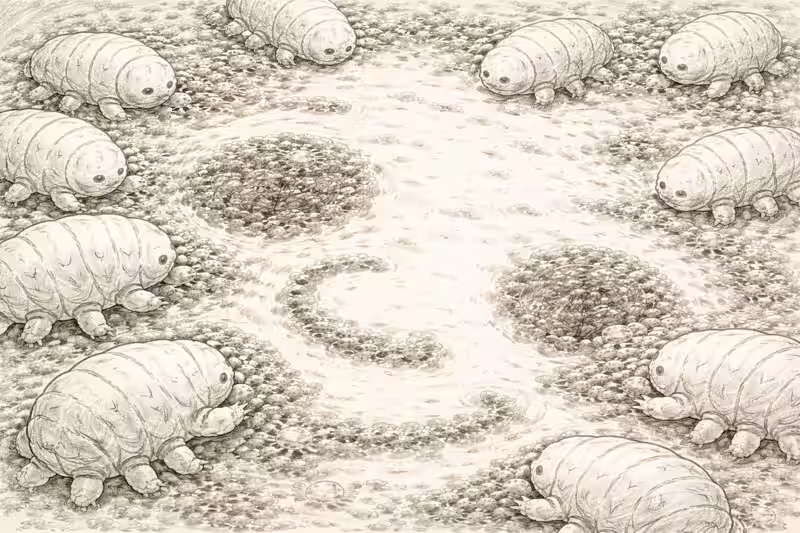
There were creatures moving across that ooze.
Jory pulled back in amazement, his loupe dropped from his eye. What the…? He frantically groped for the fallen magnifying lens and jammed it back into his eye, adjusting the tiny ring at the outside to try and focus the image better. He moved the light directly behind the gem slice.
They were tiny, but they were there. In his blurred vision, he couldn’t make out much more than blobs of shape. They reminded him of ants. They were working in clusters, nudging pellets of sludge, carrying threads of translucent matter, assembling and disassembling little hummocks with grave communal intensity.
Jory watched, spellbound.
One of the creatures stopped.
Then another.
Then everywhere he looked, the creatures no longer moved. Jory got the impression that they were looking at him.
“Amazing,” he whispered.
All at once, the whole cluster scattered into furious activity. Jory stared. They had begun moving sludge, though not randomly, and it didn’t seem like they were reverting to what they were previously doing. Little teams pushed different coloured matter into lines and curves. They rushed back and forth, climbing over each other, correcting, adjusting.
After several minutes, Jory froze.
A shape had resolved itself, reasonably clear in the blurry depths. It was, unmistakably, a face.
It was bad. As if drawn by a child. Correction, drawn by a committee of children. It was lopsided, unsteady, and lacking detail, but Jory got the impression that it was his face, or at least, an earnest attempt at it. He was sure of it. Didn’t he look at it every morning in the mirror?
The creatures clustered around their work. He couldn’t see details, but there was a strong hint of satisfaction beaming out from the tiny things.
There are moments in life when a person feels the firm hand of destiny upon their shoulder. This was not one of those moments. But he definitely felt the firm finger of destiny poking him in the ribs.
He sat back.
Then, because there was no precedent for what to do when one discovered industrious microscopic swamp-things inside a gemstone creating poor likenesses of one’s face, he bent over the gem again and said, very politely, “Well done.”
It went down well.
“How’s the progress?” his mother called from downstairs.
Jory took a moment. “Em, difficult to say!”
“That’s nice, dear.”
He slept badly that night. Not because he was frightened exactly, but because this felt a great deal messier. He felt like he’d made the most extraordinary jeweller’s discovery of the age. He thought about the cuts he’d made. Did every slice condemn entire civilisations to death? Just what did they think he was? And, more importantly, how was he ever going to sell this?
At dawn, he was back at the bench.
The face inside the Fenshard was waiting for him. It was markedly improved.
Not good, per se. No portraitist would have accepted payment for it. But where yesterday’s version had looked as if someone had dropped it, today’s was recognisably Jory. The jaw was correct. The nose was perhaps a little generous. The eyes had ceased drifting in opposite directions. At his appearance, the creatures milled around it with evident satisfaction, making tiny adjustments to the line of a cheek.
Jory tried to imagine what it must look like for them, to see his face hovering over them, with an eye the size of a moon.
Inside the gem, pandemonium erupted. Creatures darted into one another. With a speed suggesting either great intelligence or very little to lose, they altered the mouth on the sludge-face.
They made it smile.
Jory, despite his better judgment, smiled back.
This seemed to cause a small celebration. If he could hear anything, it probably sounded quite deafening inside.
Inside the gem, they moved again, this time changing the smile to a sad face, though it looked like the lower lip department wasn’t in full agreement with the artistic direction.
Jory raised an eyebrow. That was slightly insulting, truth be told.
The colony went into an immediate huddle.
Stuff this, thought Jory. I need to see clearer.
Several hours later, his mother came into his room again. “Tea, dear.”
“Not now!” he said, though his voice was somewhat muffled as he had a screwdriver in his mouth.
But she continued regardless, for mothers don’t simply stop what they’re doing on account of cutting-edge science or new branches of natural philosophy. “Are those my knitting needles?” she said, casting a sharp eye over what he’d built.
Jory had improved on last night’s design. The current apparatus involved two spring-loaded guide rails, a suspended blade frame, a calibrated water drop from the - now severely bent and reshaped - kettle, and a reciprocating pedal arrangement connected by a string to a revolving flywheel assembled from the front wheel of a child’s bicycle (who hopefully wouldn’t notice it missing for a while yet). It occupied most of the room and a fair amount of the available probability.
“With this, I should be able to get finer slices,” Jory said, making some minute adjustments.
“Are finer slices helping?”
“It means I can see inside it more clearly. There are creatures inside it.”
“Inside your machine? I won’t have you working some poor animal to the bone, Jory.” She pointed a finger at him.
“No, I mean in the gem! There are actual creatures in it.”
She peered at the fragment currently held in grips. “In there?” She didn’t seem convinced.
“Yes!”
“Well, I wouldn’t encourage them too much. If I find them in the larder, there’ll be hell to pay.”
He spent the rest of the morning in a fever of invention. He needed thinner cuts, cleaner reveals. The apparent depth inside the Fenshard bore no relation whatsoever to the thickness of the fragment. If anything, the thinner he cut, the larger and clearer the internal landscape became. The phenomenon violated several principles of lapidary craft and one or two fundamental principles of physics.
By mid-afternoon, his machine had become a marvel of delicacy and poor judgment.
The foot treadle drove the main wheel, which controlled a belt that, in turn, activated the micro-frame, lowering the edge by fractions so small they were mostly theoretical. A dripper kept the blade cool. Two balancing weights compensated for chatter. A broken piece of mirror, held with tape at just the right angle, allowed him to observe the cut while operating the treadle and avoiding the moving parts.
He looked like a man trying to shave a fly’s whiskers.
The blade hissed. A slice thinner than onion skin came away.
The creatures’ world now swam into wonderfully clear view. It should have been no more than a few grains’ worth of thickness, but instead opened out like a broad fen under mist. He could see channels in the ooze, little organised paths worn by repeated traffic. He could see structures that were, in essence, heaps of curated filth. He could see the creatures themselves, and kind of wished he couldn’t. They looked kind of like plump eyeless bugs, with 8 stumpy legs and nothing but a round hole for a mouth.
But they moved with rapid efficiency, communicating seamlessly amongst themselves as they sculpted and modified the enormous image of his own face that took up the centre of a wide, cleared space.
It was very nearly accurate.
The creatures swarmed over the cheeks, adjusting the tone and contour by moving different shades of sludge. Small teams polished the whites of the eyes with grains of pale mineral. They had managed to mimic the stubble that now covered his face, given that he had not shaved in three days at this point. The mouth, broad and rather kind, smiled gently up at him.
Despite himself, Jory smiled back. The creatures were definitely pleased with themselves.
“Lunch, dear,” said his mother, bringing in another tray of food. As Jory sat down to eat, she looked through the lens. “Oh, that is good. Much better than last night. I thought there was something off with the teeth.”
Jory stared at her open-mouthed.
“Close your mouth, dear. That really is quite disgusting to look at.” She gave him a little pat on the cheek.
Jory nearly choked on his food. “What do you mean, better? You saw it yesterday?”
“Of course, dear. I’m busy, not blind. I had a wee gander while you were sleeping.”
“I don’t know why they’re copying me.”
“They certainly seem quite taken with you. Must be because you’re so handsome.” She pinched his cheek with rather unnecessary force.
“You don’t find this…unbelievable?”
“You don’t believe it? It’s right there in front of you.”
“Yes, but think what this means. How intelligent are they? How can they move through the gem? Are they worshipping me?”
But his mother was already flapping at him as she walked away. “I’m sure you’ll figure it out, dear.”
After lunch, Jory returned to his study. His portrait was remarkably accurate now, considering it was essentially made from muck.
He smiled down at them. An immediate flurry of movement mirrored the reaction in his image. He could clearly see they were full of pride now.
They moved again, this time raising the image’s eyebrow in a mimic of the previous time. He felt his own eyebrow raise in return. The creatures raised the other eyebrow, and now he found himself looking through the lens with a permanently surprised expression.
Huh?
The little creatures were ecstatic. Eight legs meant a lot of high-fives.
It came to Jory then, as terrifying insights often do, with the calm clarity of someone else’s thought; You didn’t do that.
He had believed that because he could see them more clearly through thinner cuts, they could see him more clearly in turn. That seemed reasonable. Light passed, knowledge increased, two worlds glanced at one another across impossible geometry. His customer base would love jewellery that drew its owner, that was sure. But a niggling thought kept trying to gain his attention.
Perhaps, the direction of imitation was not as fixed as he had assumed.
What if the creatures were not merely depicting his expressions, but arriving at them first and handing them upward through the peculiar logic of the Fenshard until reality, lazy and suggestible, complied?
He looked down again. His mirror winked at him. He winked back.
Jory made a strangled noise, seized the Fenshard from the clamp, and backed away from the bench. He was downstairs and out the door in under a minute, with the gem wrapped in cloth and held at arm’s length as if it was especially pungent.
“Take a coat, dear,” his mother called after him.
The day was overcast and damp, a good reflection of his mood. The path to the swamp was a track he knew too well from lesser, more ordinary foraging trips. He splashed through puddles, slid down one bank, startled two herons and a woman collecting medicinal mould, and reached the fetid pools breathing hard. The water sat in green silence, except where darker channels slipped between the pools in thin streams that carried away rot a little at a time. Here and there, the surface twitched with insects and larvae.
Here was where Fenshards could be found. Here was where his particular Fenshard came from, if he was to believe the seller.
He stood at the edge of the pool. The cloth bundle in his hands seemed warm. He thought he sensed a slight communal bustle.
“No offence,” he told it, as he unwrapped it.
The daylight caught the wafer, and he could see his face, even without the lens. It didn’t look frightened, which he supposed was a promising sign. It looked, in so far as a face made of sludge by delighted microscopic fen-creatures could be made to look, eager, if anything. The green face staring at him was smiling, and his own face immediately snapped into place.
He could see new lines going in. They were attempting a hand.
A block of dark slime was moving into place above the likeness’s head. Was that meant to be a thought?
Jory didn’t care for the implications of that. He didn’t care for that one bit.
He flung the Fenshard as far as he could into the centre of the pool. It hit with a wet plop and vanished beneath the oily surface.
Jory stood quite still for a moment, chest heaving, waiting for the world to end. A - frankly, far too late - thought popped into his head, Am I going to drown?
Nothing happened.
Then, the muscles around his mouth pulled up, and he smiled. It was a broad, involuntary, excellent smile.
Jory clapped both hands over it at once. For one frozen second, he imagined the creature below, in the dark water and the impossible depth of the gem, still at work and absurdly pleased at being back home.
Then the smile slowly faded. He exhaled, weak with relief.
His mother raised one sceptical eyebrow at the state of his shoes as he came through the door. “Did you bring your dear old mum a present?” she said, dryly.
“I, uh, had to go to the swamp for a bit.”
“You’ll catch your death standing around in a swamp without a coat.”
Jory sighed. “I had to throw the gem away. It wasn’t…it wasn’t working out.”
“Can’t imagine why anyone would want to buy jewellery with your face on it anyway. Sandwich, dear?” She held out a plate for him. He took it wordlessly.
“I’m back to having no saleable stock.”
His mother nodded sympathetically, already returning to what she was doing. “Yes, dear.”
“And no money.”
“Not much change there, dear.”
“At least I have a new machine. I might be able to do something with that.”
“I’ll be needing my needles back now, dear.”
Jory slumped to the table and let his head drop to the surface with a thump. “Why couldn’t I have just polished it and be done with it? Why did I have to become a god?”
“That’s nice, dear.”